
Loudoun Jail VINE Coverage
Virginia Jail VINE covers participating local and regional jails. The statewide program reports full coverage of those Virginia facilities, and Loudoun County publishes its own VINE explanation. The Loudoun source describes an anonymous custody-status check and optional notification registration. This makes VINE a sound same-day channel for a person booked at the Loudoun County Adult Detention Center.
Coverage follows the custodian. VINE does not become a general record of every person whose case began in Loudoun. A transfer from the Adult Detention Center to VADOC ends the local-jail stage. Eligible state-prison notifications then use VADOC’s NAAVI system. A federal defendant may pass through a local contract bed, but federal custody must be checked through the federal court and Bureau of Prisons routes.
VINE reports an event from the participating facility. It does not certify the court disposition, explain every hold, or preserve a permanent public archive. A timely release alert can help a family member, victim, or other registered person learn that the tracked jail episode changed. The LCSO movement or release record remains the better historical proof.
Virginia law also permits requested victim notice for qualifying local prisoners before release or discharge and after transfer, escape, or a name change. Section 53.1-133.02 expressly allows VINE or a similar system to carry that notice. The statute supports VINE’s notification role. It does not make a VINE screen the jail’s signed release instrument or expand public access to protected records.
Search a Loudoun Inmate on VINELink
The safest VINELink inmate search is identity-first. Similar names can produce more than one result. Start with the last known facility and any booking identifier, age, or date-of-birth detail available from a lawful source. Never turn a missing result into a claim that the person was released.
- Open Virginia Jail VINE and select the offender-location search for Virginia.
- Enter the person’s name and any identifier the interface accepts. Use enough detail to narrow common names.
- Compare the displayed facility, age or birth information, and identifiers. Open only the record that matches.
- Read the custody status and event label word for word. Record the event date and reporting facility if displayed.
- If the status or identity remains unclear, call the Loudoun County Adult Detention Center at 703-777-0405 or request the LCSO transaction record.
A person who is absent might have a misspelled name, a record outside public scope, a completed event, or custody in another system. A county-jail record also cannot answer a VADOC, BOP, or ICE question. The broader Loudoun released-inmate verification path explains how court, state, federal, and records-request sources fit together.
The official VADOC notification source shows the separate state-prison route captured below.
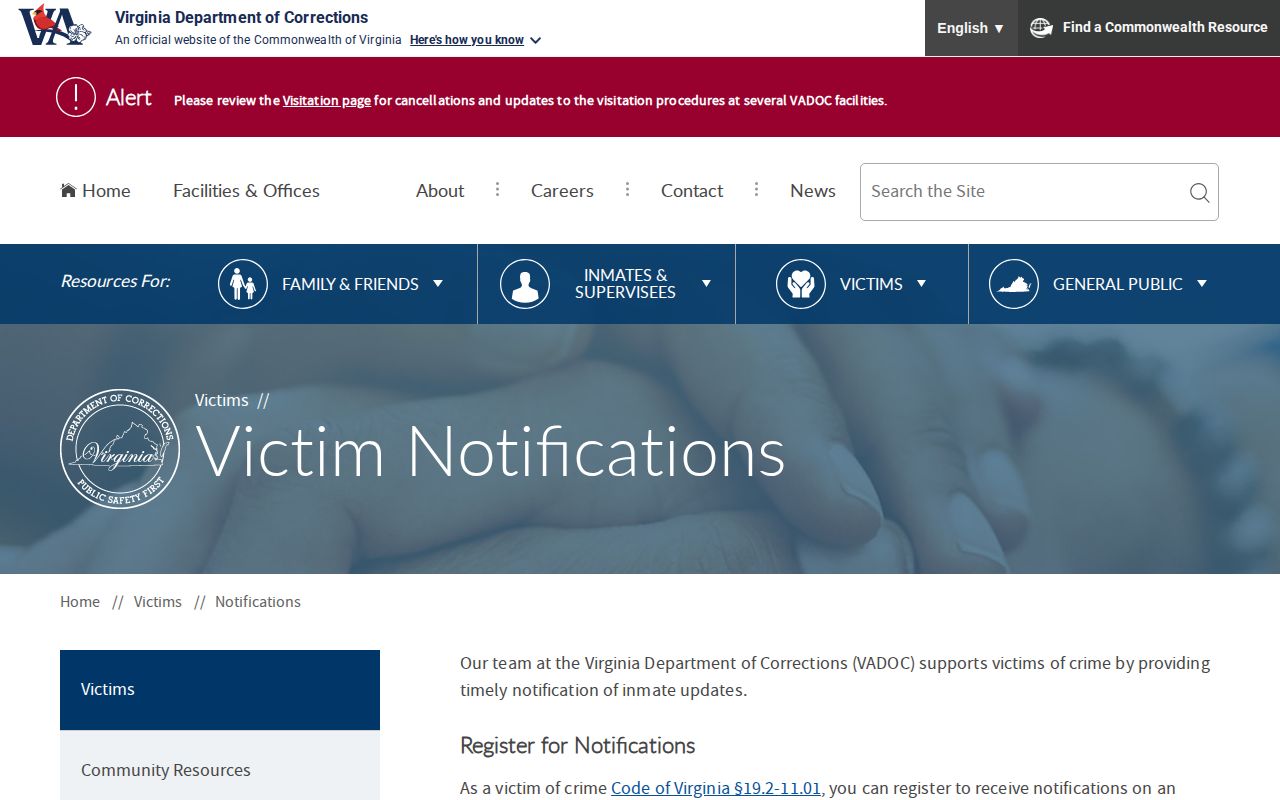
The state page confirms that local-jail VINE and post-conviction VADOC notification are related services with different registration systems.
Loudoun VINELink Release Fields
The live record wording controls. Available fields can vary by facility and interface, so transcribe the result instead of substituting a preferred term. The core task is to link the correct identity with the exact custody event.
| Field or event | What it can establish |
|---|---|
| Name and identifier | Helps distinguish the tracked person from another person with the same or similar name. |
| Facility | Names the local or regional jail reporting the custody episode. |
| Custody status | Shows the status used by VINE at the time of the check, subject to update limits. |
| Release | Signals that the reported incarceration episode ended; destination still requires confirmation. |
| Transfer | Shows movement to another custodian, not return to the community. |
| Escape or return | Reports an unauthorized departure or return event, not a lawful discharge. |
| Death | Ends the custody episode but must never be described as community release. |
A released label can be useful, but the next destination matters. Loudoun may release a person on bond, discharge a sentence, send a state-sentenced prisoner to VADOC, transfer the person to another jail or hospital, or hand custody to another authority. Only the movement record or direct agency confirmation resolves that difference.
VINE is not the state offender locator. A VADOC district entry can show that a person is in the community under state supervision. A state-facility entry means secure custody continues. Those facts belong to the VADOC Inmate and Supervisee Locator rather than the Loudoun jail VINE result.
Register for Loudoun Release Alerts
Registration begins only after the correct person has been selected. The interface may offer phone, email, text, TTY, or other methods depending on the facility and current service. Follow the choices shown on screen. Do not publish the registration confirmation or private contact details.
- Open the matching person’s record and choose the registration or notification option.
- Select an available method and enter the requested phone number, email address, or other contact information.
- Complete the confirmation shown by the service. Save the registration details in a private place.
- For telephone registration, create a PIN. The official Virginia brochure says the PIN acknowledges a notification call and stops repeat calls.
- When an alert arrives, listen to or read the full event. Confirm a release destination with LCSO if community return matters.
Telephone alerts come from 800-467-4943 according to the local research. Entering the chosen PIN acknowledges receipt. The PIN does not establish anyone’s identity, conviction, court result, or legal authority to receive other records. It serves a narrow notification function.
Registration ends uncertainty about neither timing nor destination. Data enters VINE from the reporting facility, and an event can be corrected. Keep the event wording, date, and facility, then compare them with the jail or court record if a durable answer is needed.
Loudoun VINE to NAAVI Handoff
Loudoun has a distinctive local-to-state handoff. The Adult Detention Center can hold a person before delivery to VADOC. Virginia Jail VINE may report the transfer out of Loudoun, but it does not carry that registration into the state-prison notification program. The two registrations are not connected.
NAAVI is VADOC’s notification service for eligible crime victims and qualifying immediate family. It is not the public offender locator, and its eligibility rules are narrower than the ability to perform an anonymous VINE custody check. VADOC lists such events as transfer, advanced release, release, death, name change, work release, escape, recapture, parole interview, and parole decision among possible notices.
VADOC generally describes advance release notice as about thirty days before release and sends a new notice if the date changes. That is not a guaranteed thirty-day countdown for every case. A court change, calculation update, detainer, or other event may alter the schedule.
The VADOC locator remains separate from NAAVI. The locator is the public search for people in state facilities or under certain community supervision. NAAVI registration is an eligibility-based notification relationship. Someone who can search a VADOC name is not thereby registered for notices, and an eligible registrant should not rely on periodic locator checks as a substitute for the program’s instructions.
Loudoun VINELink Search Limits
VINELink is a notification and custody-check service, not a certified discharge instrument. Updates depend on information from the participating facility. A recent transaction can lag, and a past result may no longer be searchable. Loudoun County did not publish a verified rolling 24-hour or 72-hour release feed during the research, so VINE is useful as an event source but not as a substitute archive.
The service does not cover every custody system. BOP has its own locator for federal prisoners. ICE operates a current detention locator, and a no-result there does not prove release. VADOC uses its Inmate and Supervisee Locator for public state custody and supervision information. Juvenile cases and identities are generally confidential and do not belong in the adult public workflow.
The Virginia State Police registry is another distinct source. It applies only when the offense creates a legal registration duty. A registry result can remain visible after a custody term, but it does not establish when Loudoun released the person or which supervision rules apply. Checking VINE, the VADOC locator, or the registry should always start with the question that the particular system is designed to answer.
For durable Loudoun proof, request the person’s actual release date and time, release reason, and destination or receiving agency from LCSO Records Services. Compare the response with the relevant criminal case. VINE answers what event the service reported. The jail record answers what Loudoun did with physical custody.
Confirm a Loudoun VINE Release
Start with the alert details. Verify the name, facility, date, and event label. If the event says release, ask whether Loudoun returned the person to the community or ended only its own hold. If it says transfer, identify the receiving agency and continue with that system.
Call the Adult Detention Center for a same-day clarification. For an auditable response, use the LCSO records request portal. Ask for the named booking’s actual release date and time, disposition or release code, and destination or receiving authority. A narrow request is more useful than asking the agency to interpret an alert.
Then check the legal source. A Loudoun General District or Circuit Court case can show bond, dismissal, sentence, appeal, suspended time, or probation, but it may not show the exact physical release time. If VADOC received the person, use the state locator and state notification documents. If the case is federal, use federal court and BOP records. Each channel answers its own part of the custody path.
Note: Once VINE reports release from the tracked episode, later history should be proved through the jail record, court, or new custodian.