
Loudoun Projected and Actual Release
A projected, estimated, or calculated release date is an agency computation based on the information then in effect. An actual release date records what occurred. The two may match, but they answer different questions. Courts enter sentences. Jail and VADOC time-computation staff apply credit and sentence structure. The custodian records the physical release, discharge, parole, or transfer.
Pretrial custody is different. A defendant held at the Loudoun County Adult Detention Center before disposition has no sentence term to count down. A magistrate or court may set bond, change conditions, dismiss a charge, or continue detention. Even after a bond order, jail processing and other holds can affect when the person physically leaves.
A state sentence does not always mean immediate movement to a VADOC prison. Loudoun reports that some people can remain in the local jail while awaiting delivery to VADOC, including when an appeal stays the transfer. Identify who is computing the term before comparing dates.
Find a Loudoun Release Date
Begin with the last known custodian. The Loudoun jail, VADOC, and federal authorities keep different records. A date from one system cannot be relabeled as the date from another. Use the person’s full name, booking number, DOC ID, case number, and sentencing court to keep the records tied to the same individual.
- Determine whether the person is pretrial, serving a local sentence, awaiting VADOC transfer, in VADOC custody, or in federal custody.
- For a VADOC prisoner, search the Inmate and Supervisee Locator by seven-digit DOC ID when possible. Read any calculated or estimated date label exactly as displayed.
- For a Loudoun jail sentence, obtain the commitment order and contact the Adult Detention Center or LCSO records channel for the calculation and actual transaction.
- Read the sentencing case for imposed time, suspended time, concurrent or consecutive terms, amendments, and documented jail credit.
- Ask whether another sentence, warrant, detainer, appeal, or receiving agency changes the expected destination.
- After the date passes, request the actual release time, reason, and destination. Do not convert a missing roster entry into proof of community release.
The VADOC public locator is updated daily but disclaims perfect currency. The public search page did not expose a stable exact field label during research, and a reproducible individual result could not be captured. Use “calculated or estimated release-date information, if displayed” unless the live result supplies a more exact phrase.
The full Loudoun released-inmate record process covers court, county, state, federal, and records-request channels when an old date is no longer visible online.
VADOC Time Computation for Loudoun
VADOC’s Time Computation unit applies sentencing orders, prior jail time, total imposed time, consecutive and concurrent structure, statutory credits, earning-class changes, disciplinary events, and later legal changes. The official source is shown below.
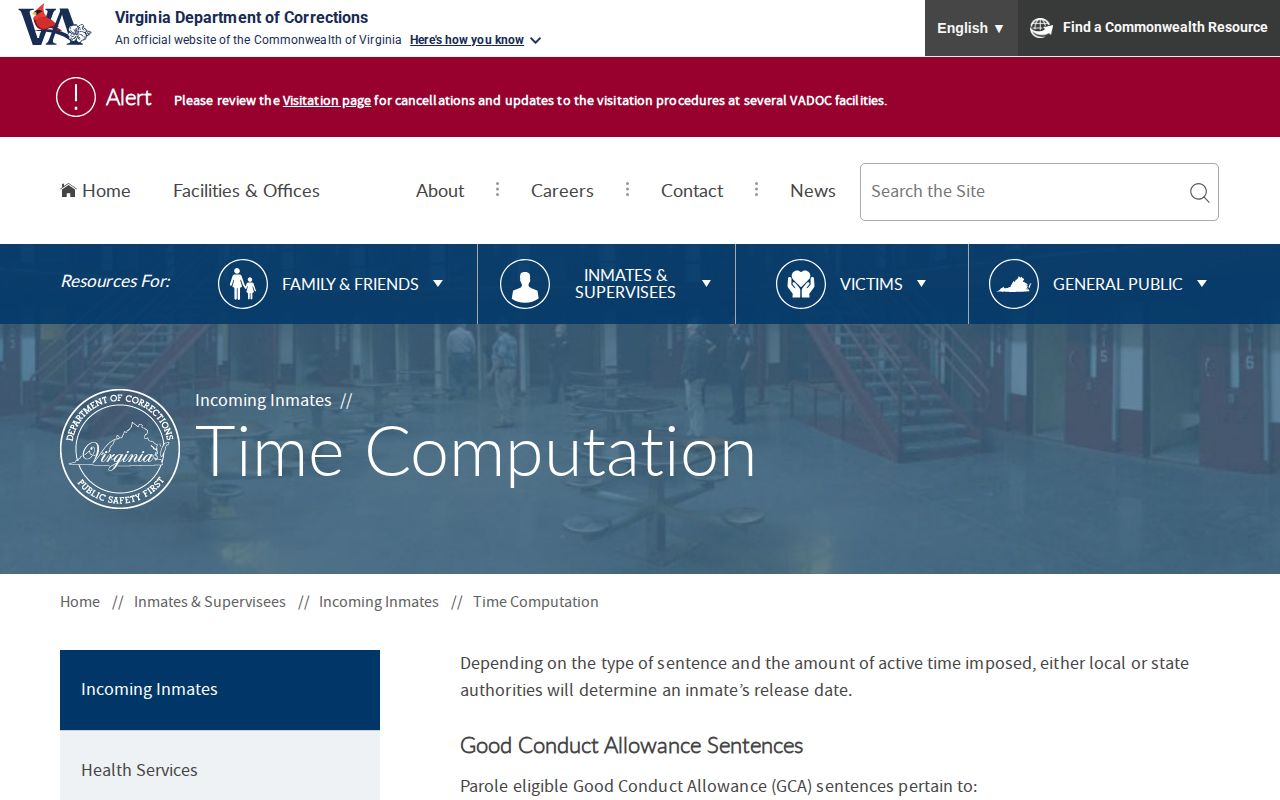
The VADOC explanation supports a sentence-specific calculation. It does not supply a universal release-date formula for every Loudoun case.
For computation questions, VADOC directs correspondence to its Correspondence Unit and Court & Legal Section at P.O. Box 26963, 6900 Atmore Drive, Richmond, VA 23261. Include the DOC ID and enough sentence detail to identify the record. The signed court order remains essential if an imposed term, credit, or amendment appears wrong.
VADOC release paperwork also matters. A person leaving on discharge or parole reviews and signs the applicable documents, which can include an Order of Release, Conditions of Probation, or Conditions of Parole. A notification-of-release letter and the resulting locator status help distinguish a calculation from the completed event.
Virginia Credits and Loudoun Release Dates
Virginia uses different credit structures based largely on offense and sentence dates. VADOC describes Good Conduct Allowance, or GCA, for older-law categories and Earned Sentence Credit, or ESC, for many felony offenses committed on or after January 1, 1995. The applicable scheme must be identified before anyone estimates time remaining.
GCA generally concerns felony offenses before 1995 and misdemeanor offenses before July 1, 2008. For qualifying parole-eligible active or combined terms longer than twelve months, VADOC can compute discretionary-parole eligibility, mandatory-parole release, and good-time release dates. The old-law class structure can range from no credit to thirty days of credit per thirty days served under the controlling provisions.
ESC generally applies to post-1994 felony offenses. VADOC distinguishes an ESC-1 group that may earn from zero through 4.5 days per thirty days and an eligible ESC-2 group that may earn from zero through fifteen days per thirty days, depending on class. Virginia Code § 53.1-202.2 addresses applicability, while § 53.1-202.3 sets credit rates and important offense exclusions.
The familiar “about 85 percent” phrase is not a safe promise. The original 4.5-days-per-thirty rate produces about 86.96 percent, not exactly 85 percent, before other sentence-specific issues. Higher credit rates do not apply to every offense. Current statutes and VADOC’s individual computation control.
Note: Never subtract a broad credit rate from the sentence and publish the result as a Loudoun County release date.
Loudoun Jail Sentence Calculations
A local jail sentence requires the actual commitment order, credit for time served, the applicable local good-conduct treatment, and any other orders or holds. The Adult Detention Center states that people receiving twelve months or less serve there, while some state-sentenced people may remain longer before VADOC delivery. That makes the custodian and sentence status more useful than the building name alone.
For a named record, ask LCSO for the booking and release transaction, including the actual release date and time, release disposition, and destination. The court record can show the sentence and suspended time, yet it may not show the jail’s physical timestamp. If the order changes, obtain the amended version rather than recalculating from an older docket entry.
Loudoun did not publish a fixed release hour, weekend shortcut, public pickup door, or general date-adjustment rule in the official material reviewed. Do not import a practice from another Virginia jail. The Adult Detention Center information line, 703-777-0405, is the direct route for current local operations.
A departure can also mean transfer. Delivery to VADOC, movement to another jail or hospital, or a handoff under another authority ends the Loudoun placement without ending custody. Request the destination field whenever return to the community is the question.
Why Loudoun Release Dates Change
A calculation uses the known record at one point in time. New legal and custody events can change it. Some factors move the computed end date. Others leave the date intact but prevent community return because another authority takes custody.
| Factor | Effect on the release path |
|---|---|
| Jail credit | Verified time already served can reduce the remaining active term. |
| Earning-class change | A different statutory or conduct class changes the pace of eligible credit. |
| Disciplinary event | Loss or reduction of credit can move a calculation later. |
| Amended court order | A correction, suspension, or new term can change the sentence structure. |
| Concurrent or consecutive term | The relationship among sentences changes the total time computation. |
| Parole action | A grant, denial, revocation, or later action alters an eligible old-law path. |
| Detainer or new hold | The sentence may end, but another agency can receive the person instead of community release. |
Always name the changed event and authority. “LCSO released to VADOC,” “VADOC discharged to probation,” and “BOP reports no longer in BOP custody” describe different outcomes. A bare phrase such as “released from Loudoun” hides the part that matters most.
Parole and Loudoun Release Timing
Virginia abolished discretionary parole for most felony offenses committed on or after January 1, 1995 through § 53.1-165.1, subject to exceptions. Many current sentences therefore end through computed discharge rather than a discretionary parole grant. Older offenses and special statutory categories need individual review.
For parole-eligible sentences, § 53.1-151 contains different eligibility fractions and caps based on prior commitments and other categories. Eligibility marks when review may occur. It is not the release date. A Board grant also is not the gate time because VADOC still completes release planning, documents, notice, and detainer review.
Monthly Board decisions can establish the action and decision date. The VADOC locator and signed release documents establish whether the custody status later changed. If a parole grant and facility entry coexist, treat the person as still shown in custody until VADOC records the release event.
State and Loudoun Release Hours
VADOC’s facility release guidance says discharge or parole release from a VADOC facility occurs by 11:59 p.m. on the release date, weather permitting. It also describes release papers, personal property, funds, medication, approved pickup, and transportation planning for state prisoners.
That statewide statement does not govern the Loudoun County Adult Detention Center. Loudoun published no matching routine jail release hour in the sources reviewed. A person finishing a county sentence or bonding out should confirm local processing with the jail. Applying VADOC’s deadline to LCSO would create a false promise.
The distinction also affects pickup plans. A scheduled VADOC date and a local court action can both be correct, yet they belong to different facilities and procedures. Verify the actual custodian, current weather or transport conditions, any approved pickup instructions, and any detainer before making a trip.
Confirm Loudoun Actual Release
A date becomes historical fact only after the custodian records the transaction. For Loudoun jail custody, obtain the actual release date and time, reason, and receiving agency from LCSO and compare the court disposition. For VADOC, use the locator, signed release papers, notification-of-release letter, and VADOC records.
A notification can help with timing. Virginia Jail VINE applies to the Loudoun local-jail episode, while NAAVI serves eligible VADOC notifications after state transfer. The separate Loudoun VINELink inmate search explains how the local-to-state handoff changes registration. Neither service replaces the final release document.
Federal and immigration paths require their own sources. A BOP date concerns federal custody, and an ICE locator is mainly a current detention tool. A state or local release can lead directly into another authority’s custody. When destination matters, the receiving-agency field is as important as the date.
Keep a copy of the result and note when it was checked. If the estimate later changes, compare the newer agency record rather than editing the old value from memory.
Note: Preserve the exact agency label and date wording so an estimate, parole decision, transfer, and completed release are never collapsed into one event.