
Loudoun Juvenile Release Limits
The Loudoun County Juvenile Detention Center belongs to the county youth and juvenile justice system. It is mapped because it is a detention facility in Loudoun County, but it is not an adult jail and is not a public released-inmate lookup channel. Juvenile court and social records receive confidentiality protections. Names, photographs, case facts, and custody events should not be surfaced merely because adult records may be public in another system.
A juvenile may leave detention because a court orders release, placement changes, another agency assumes responsibility, or the case reaches another stage. Those possibilities do not create a public release feed. The authorized case team and Juvenile and Domestic Relations District Court hold the controlling details. The public adult tools cannot fill that gap.
Do not enter a child’s details into an adult inmate tool or treat a missing public record as proof of release.
Confirm Authorized Juvenile Release
Only a person with a lawful role should seek a juvenile custody or release update. The proper route depends on that role and the order governing the child. A parent or guardian may receive instructions from the facility or case worker. An attorney should use the case and agency channels available to counsel. A victim-services professional should follow the notification process that applies to the underlying matter.
- Identify the agency or court contact already assigned to the juvenile matter.
- State the requester’s relationship and be ready to follow identity and authority checks.
- Ask which office may confirm custody, placement, or release without requesting protected facts by public email.
- Use the Juvenile and Domestic Relations District Court process for the governing case when directed.
- Keep any release terms within the circle authorized by law and the court.
This is a closed-channel workflow. It differs from the adult Loudoun County release search, which uses Sheriff records, Virginia Jail VINE, adult court portals, and state or federal locators. None of those adult pathways should be presented as a substitute for juvenile authorization.
Loudoun Juvenile Record Boundaries
Several record types can exist without being open to the public. The detention facility may hold admission, movement, property, and discharge data. The court maintains case orders and hearing history. A supervising or youth-services agency may hold placement and service records. Each source has its own access limits, and a requester’s authority may differ from one record to another.
| Record source | Correct access approach |
|---|---|
| Juvenile detention record | Use the facility or responsible agency’s confidential process |
| J&DR case record | Contact the court as an authorized party |
| Placement or supervision file | Follow the assigned agency’s identity and consent rules |
| Adult jail record | Do not use for a juvenile detention event |
| Public release list | No official Loudoun juvenile release list was identified |
A public-record request does not override confidentiality. Virginia FOIA is a means of seeking existing public records, but protected juvenile material remains protected. An agency may explain that records cannot be released or may require the requester to use a different statutory or court process.
Loudoun Juvenile Facility Contact
The official county facility page is the safest public starting point because it provides the current agency context and routing. Sensitive facts should not be placed in an ordinary message unless the office directs that method. Ask first what proof of identity, guardianship, representation, consent, or case connection is required.
Loudoun County juvenile justice system
Official facility information
The official page shown below identifies the Loudoun County juvenile facility, but it is not a public roster or a gallery of released children.
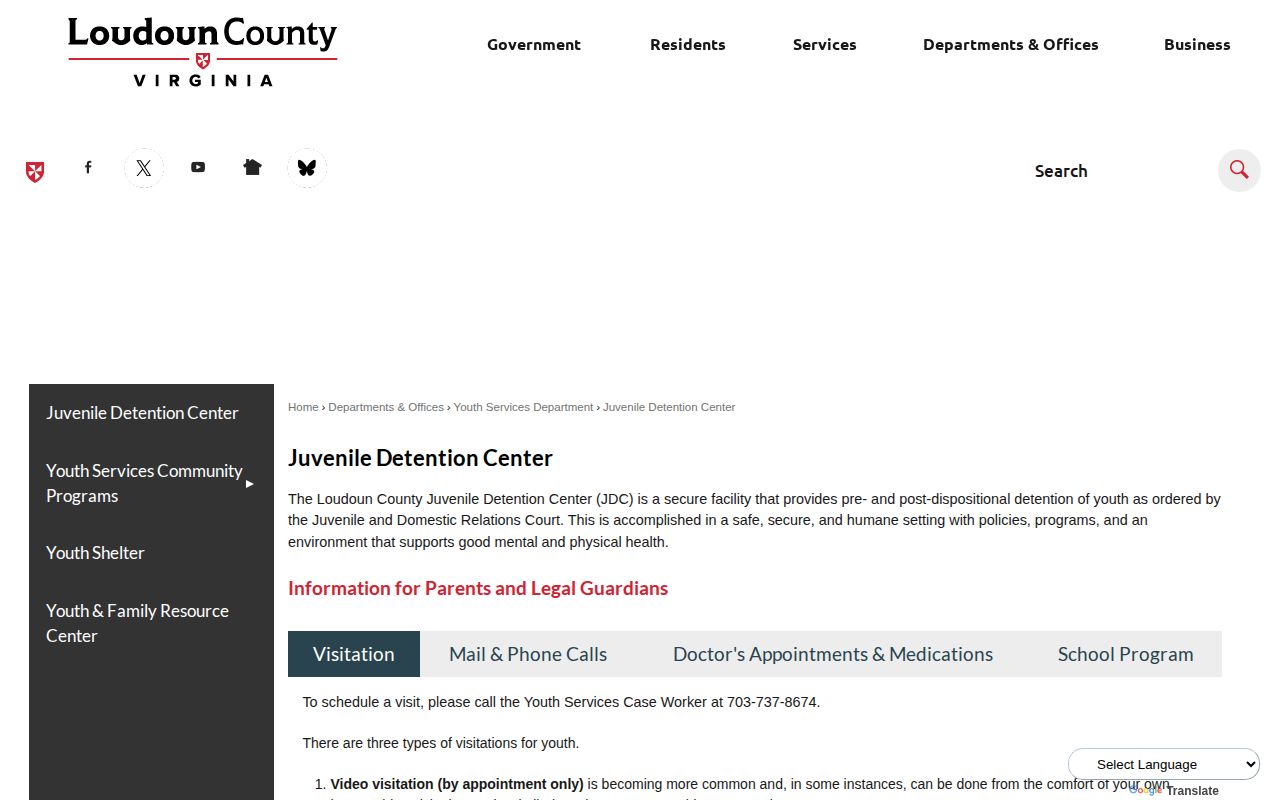
The screen supports agency identification only. It should not be read as evidence about any named child’s detention, case, placement, or release.
No Loudoun Juvenile Roster
The research found no official public juvenile roster, recent-release list, mugshot page, or searchable discharge archive. That absence reflects the facility’s distinct legal setting and must be preserved. An adult jail roster is not a proxy. A county news item is not a full record. Social media is not an authorized case source.
Virginia Jail VINE is documented for participating local and regional jails, but it should not be promised as a public juvenile lookup without clear official confirmation for the specific facility and requester. VADOC’s Inmate & Supervisee Locator concerns state correctional custody and community supervision, not this county juvenile placement. The BOP and ICE locators serve still different systems.
- Confidential
- Not open to ordinary public inspection, though an authorized person may have a lawful route.
- Sealed
- Access is restricted by law or order; sealing does not mean an event never occurred.
- Release
- The end of a stated custody event, which may still lead to placement or supervision elsewhere.
- Transfer
- Movement to another custodian rather than a return to the community.
Juvenile and Adult Release Differences
Adult Loudoun jail records can include booking data, actual release time, reason, destination, bond information, and a booking photograph, subject to applicable law. The adult process can use LCSO Records Services and public court systems. A juvenile case cannot be presumed to expose those same fields. Even a field that exists internally may remain unavailable outside the authorized process.
| Question | Adult local jail | Juvenile detention |
|---|---|---|
| Public named search | Use documented adult channels | Do not assume public access |
| Release record request | LCSO records route may apply | Use confidential agency or court route |
| Booking photograph | May be requested for a nonjuvenile booking | Do not seek or republish as adult material |
| Court search | Adult district and circuit portals | Authorized J&DR access |
| Missing result | Requires other custody checks | Expected and not proof of status |
These boundaries protect accuracy as well as privacy. Mixing systems can attach an adult record to a child with a similar name, imply a case outcome that is not public, or expose information outside its lawful context.
After Loudoun Juvenile Release
Release from secure detention does not necessarily end court involvement or youth-services responsibility. The court may set conditions, direct a placement, or retain jurisdiction. A supervising agency may provide private instructions to the child and authorized adults. Those instructions, not a public web search, control what happens next.
Transportation, pickup, property, medication, school, and placement details should be obtained directly from the responsible team. The adult jail’s Route 56 transit information, scanned-mail pickup rule, work-release charges, and VADOC release-by-time statement do not belong here. They concern different facilities and populations.
If records conflict, an authorized requester should bring the conflict to the agency or court that created the controlling order. Public speculation is unsafe. Note: The least public channel is often the correct channel for a Loudoun juvenile custody question.
Loudoun Juvenile Publication Caution
No name, image, allegation, charge, court event, or release claim should be published to make an adult site appear complete. Juvenile confidentiality is not a missing-data problem to solve. It is a boundary to honor. Even facts received by an authorized family member may carry limits on wider disclosure.
Use the facility page to locate the responsible office. Use the J&DR court route when directed. Share only what the law, court, and agency permit. A public reader can accurately conclude only that Loudoun operates a juvenile detention facility and that its records follow confidential channels. Anything more must come from a lawful, case-specific source.
Loudoun Juvenile Agency Routes
The county's Juvenile and Domestic Relations District Court information provides the local judicial-services route. The Loudoun Virginia Court System page explains how local court divisions connect. These official pages help an authorized person identify the right office. Neither page opens confidential juvenile facts to an ordinary public search.
Contact the office first and ask what authority and identification it requires. A public-record form, adult case portal, or general county telephone tree cannot bypass the juvenile process. The facility, assigned agency, and court can each disclose only what the law and the requester's role permit.
An authorized request should be narrow. Name the case or agency relationship without sending private facts through an unsecured public channel. Ask where identity papers should be presented and whether the answer must come through counsel, a guardian, or the assigned worker. If the office cannot discuss the matter, that refusal must not be converted into a claim that the child was released. Confidentiality can produce no public answer even when a valid custody event exists.