
Loudoun Probation and Parole Compared
Four systems can sound alike in Loudoun County. They do different work. Virginia parole permits a parole-eligible prisoner to serve part of a sentence in the community under Parole Board authority. State probation is ordered by a sentencing court and supervised by Virginia Department of Corrections Community Corrections. Loudoun County also has a local Probation Division for court-referred adults, often in lower-level cases. Its Pretrial Division can supervise a defendant released on bond before the case ends. Pretrial release is not probation after conviction and is never parole.
The order or decision controls. A person may leave the Loudoun County Adult Detention Center on bond with local pretrial terms, finish a short jail term with local probation, transfer to VADOC, or leave a state prison on parole or probation. The fact of physical release does not identify which path applies.
| Supervision | Who authorizes it | Best verification source |
|---|---|---|
| Parole | Virginia Parole Board for an eligible state sentence | Board decision, VADOC locator, and release papers |
| State probation | Sentencing court | Court order, VADOC locator, and supervising district |
| Loudoun local probation | Loudoun court referral | Court record and Loudoun Community Corrections |
| Pretrial supervised release | Court as a bond condition before disposition | Bond order, pending case, and Pretrial Division |
These terms help separate the records:
- Parole
- Community release under Parole Board authority before a parole-eligible sentence fully expires.
- Probation
- Court-ordered community supervision, often tied to suspended time or other sentence terms.
- Absconder
- A supervisee alleged to have stopped reporting or left supervision without permission. The supervising authority must verify the status.
- Discharge
- Formal completion or termination of custody or supervision, shown by the responsible agency or court record.
Verify Loudoun Post-Release Supervision
The public starting point for state supervision is the VADOC Inmate and Supervisee Locator. It includes people in state facilities and people supervised by district offices, including probationers, parolees, and Community Corrections Alternative Program participants. The locator is updated daily, yet it warns that information may be incomplete or out of date. It is not a full supervision file.
- Search with the seven-digit DOC ID when known. Otherwise enter at least the first three letters of the first name and the full last name.
- Use age range, race, gender, or location only to distinguish similar names. Compare every displayed identifier before relying on a result.
- Read the location and category exactly. A state facility means custody continues. A district or supervisee entry points to community supervision.
- Compare the result with the Loudoun court case or Parole Board decision. The legal source shows who imposed supervision and why.
- Contact the listed office for the proper public channel. Reporting rules and personal conditions come from the officer and signed papers, not a general web entry.
A person wholly discharged from VADOC custody and supervision may fall outside the locator’s stated coverage. A no-result can also come from spelling, a local-only case, a federal matter, or a data issue. For the original Loudoun release transaction and the full named-person search path, use the Loudoun County released-inmate search and record process.
Loudoun Supervision Offices and Records
VADOC District 25 in Leesburg serves Loudoun, Fauquier, and Rappahannock Counties. It is the local field office for VADOC state probation and parole. Loudoun Community Corrections is a county program with separate pretrial and local probation work. Calling one office about the other program may not resolve the question, so identify the order and agency first.
VADOC District 25
751-D Miller Drive
Leesburg, VA
703-771-2510
State probation and parole supervision for the district.
Loudoun Pretrial Division
Supervision tied to a court’s bond order
703-777-0107
The public directory identifies an office, not an individual’s next check-in or private case instructions. A supervisee should use the directions issued by the officer. An authorized person seeking a definitive end date should request the discharge order or agency record rather than treating a directory entry as proof.
The court level can also identify the local path. Loudoun General District Court handles many misdemeanor matters and preliminary felony steps. Circuit Court handles felony dispositions and district appeals within its jurisdiction. Juvenile and Domestic Relations District Court can make adult referrals within its own jurisdiction. When a case moves or is appealed, follow the controlling case rather than assuming the first court entry contains the final probation order.
The Virginia Parole Board website shows the official Board routes used for eligible cases. Its structure and decision sources are visible in the official capture below.
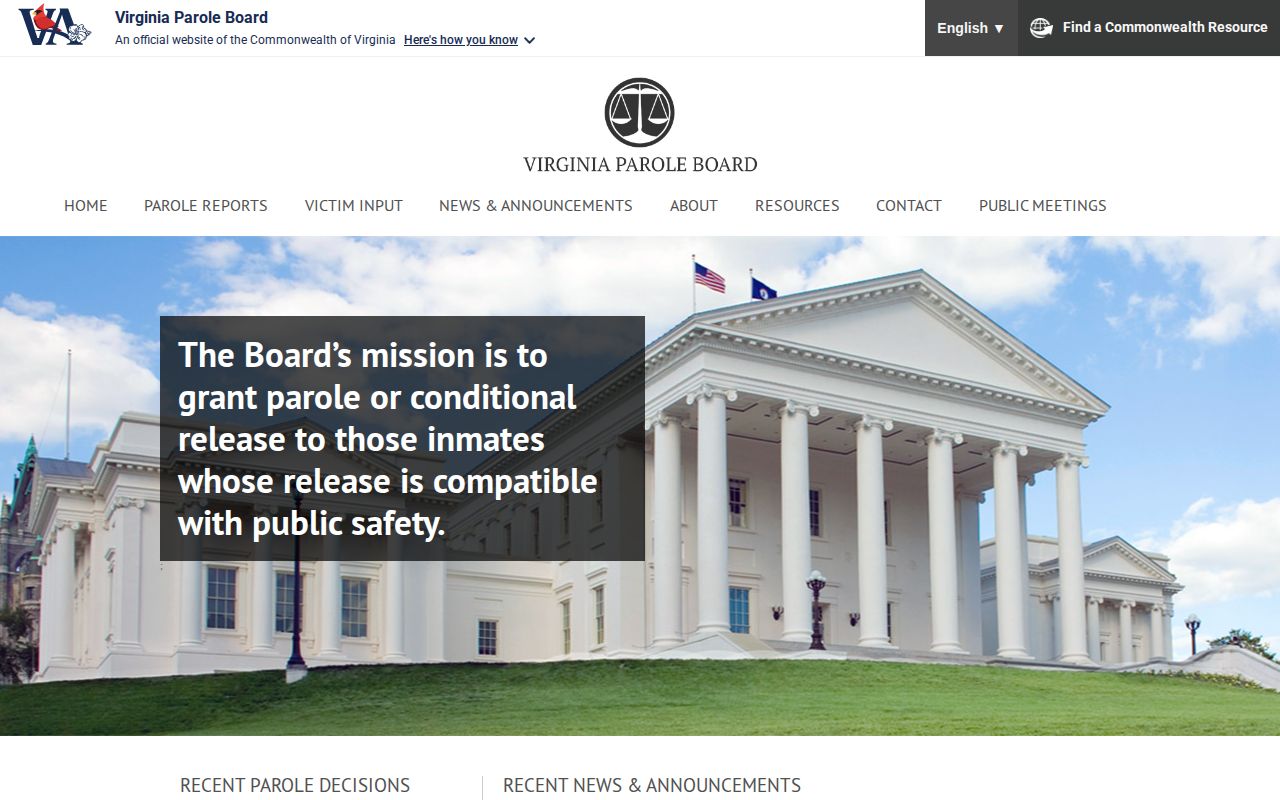
The Board source helps establish parole action, while VADOC custody and release records establish whether physical release and field supervision followed.
Loudoun Parole Decisions and Eligibility
Virginia abolished discretionary parole for most felony offenses committed on or after January 1, 1995 through Virginia Code § 53.1-165.1, with statutory exceptions. This is why many modern Loudoun cases lead to sentence discharge plus court-ordered probation rather than a discretionary parole release. Offense date, sentence date, prior commitments, special categories, and the current text of the law all matter.
For a parole-eligible first commitment, § 53.1-151 can set an initial threshold at one-quarter of the term or twelve years if that quarter is longer. Later commitments use different fractions and caps. Life terms and listed serious offenses have separate rules. These rules establish eligibility for review, not a promised grant or release day.
The Board’s public meeting page is event-driven and posted as meetings are scheduled. Since July 2024, public final deliberation and voting apply when the Board is inclined to grant discretionary parole or geriatric conditional release. Not every eligible person receives a public meeting. Agendas, streams, and minutes therefore cannot be read as a complete calendar of all interviews.
Monthly parole decision reports can show DOC number, decision date, decision, reasons, jurisdiction, convictions, sentence information, and Board votes. A grant proves Board action. It does not prove that the prison gate opened that day. VADOC must still finish release papers, notices, planning, and detainer review.
Loudoun Supervision Violations and Warrants
Conditions vary by order and person. Common high-level duties can include reporting, following travel limits, completing programs, paying court obligations, and obeying laws. Only the signed conditions, sentencing order, or supervision record states the actual terms. The public locator does not display the full set of instructions and should not be used to fill gaps.
A missed appointment does not by itself prove absconder status. The research found no complete Loudoun County parole-absconder list. VADOC’s statewide wanted material is also not a list of every alleged supervision violation. Verify a warrant through the responsible court or law-enforcement process and confirm the supervision action with VADOC or the local program.
Parole violation outcomes may include continuation or revocation. Board reports sometimes show the alleged violated conditions and the vote. Probation violations return to the court that imposed probation. Pretrial violations belong to the pending criminal case. Each path has a different decision maker, even if an arrest causes the person to return to the same Loudoun jail.
A return to custody also does not reveal the final outcome. The person may remain held while a court or Board considers the alleged violation, may continue under supervision, or may face a revocation order. Compare the new jail episode with the violation docket and later decision. Custody status, the allegation, and the final ruling are three separate facts.
Note: A custody notification may report a new jail event, but VINE does not serve as the official supervision-violation or warrant record.
Loudoun Reentry Beyond Supervision
Loudoun County maintains both Reentry Services and a Reentry Advisory Council. This local layer helps people navigate identification and government records, courts, transportation, health, nutrition, veterans services, and referrals. Those services can support a transition home, but they do not confirm that a person was released or identify probation and parole status.
The Advisory Council’s published schedule says it normally meets on the second Wednesday of every other month. The listed meeting place is Loudoun County Animal Services at 42225 Adoption Drive in Leesburg. Anyone planning to attend should check the current county posting because dates and locations can change.
Reentry staff do not replace a supervising officer. A person may use reentry services while on probation, parole, local supervision, or no supervision at all. Status proof still comes from the court, Board, VADOC, or county program responsible for the order.
Loudoun Probation and Parole Discharge
Supervision ends through a formal act. State parole and probation records should identify the discharge or termination under VADOC, Board, and court authority. Loudoun local probation ends under the applicable court and county program record. A pretrial supervision term changes when the court modifies bond, resolves the case, or enters another order.
Keep the final order, discharge paper, and any VADOC notification-of-release or supervision document. A person’s disappearance from the locator is not a substitute. It might reflect complete discharge, but it can also reflect data limits or a move outside the locator’s coverage. When the sources conflict, the signed order and responsible office provide the soundest answer.
State-prison, county-jail, and federal paths remain distinct. The Parole Board and VADOC do not verify a local bond release unless state supervision is involved. A federal term is checked through federal court and the Bureau of Prisons, not the Loudoun probation offices. Naming the authority prevents a transfer or program change from being mistaken for final discharge.